

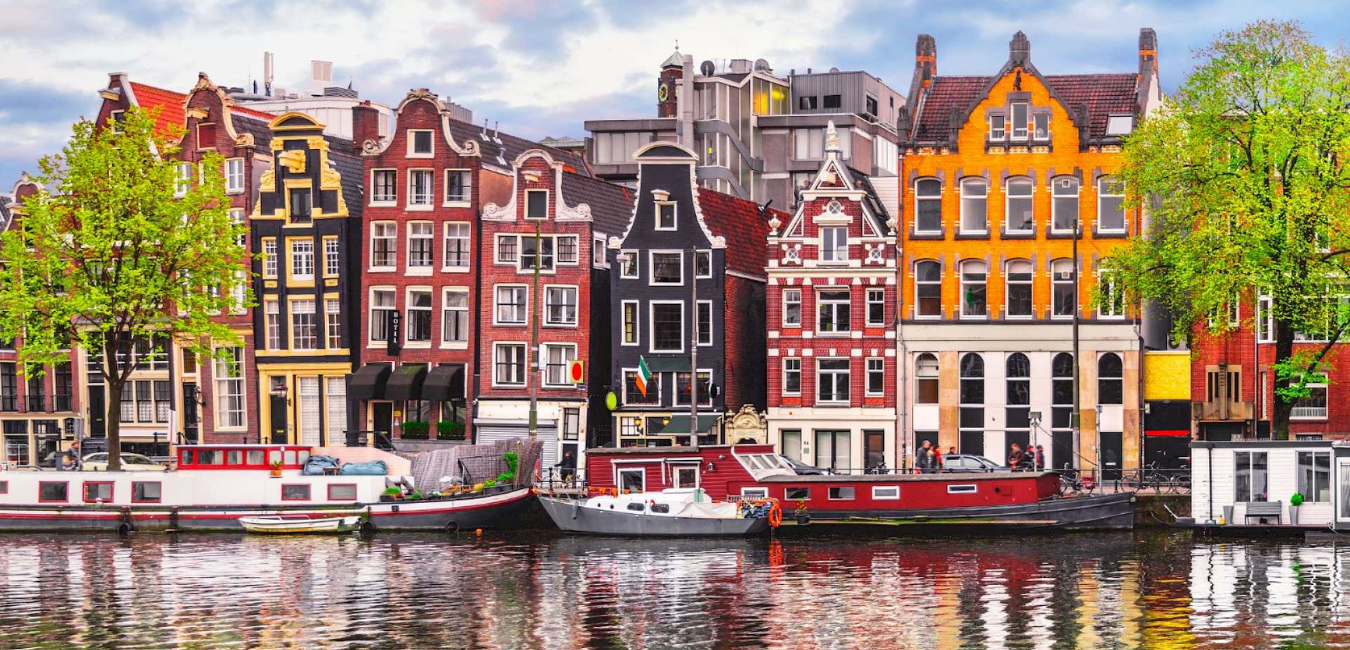
Amsterdam doesn’t try to imitate the architectural grandeur of cities like Paris, Rome, or Vienna. It doesn’t need to. Its charm lies in its individuality—a mix of necessity, innovation, and a stubborn refusal to follow the rules of others. Wander its streets or cruise its canals and you’ll realize something quickly: this city wasn’t built to impress, it was built to work, and somehow that utilitarian mindset turned into one of Europe’s most iconic and unforgettable urban aesthetics.
Built on Water, Built with Purpose

What makes Amsterdam’s architecture truly stand apart begins, quite literally, from the ground up. The entire city is built on marshy ground, and to make construction possible, thousands of wooden piles were driven deep into the wet soil. This unstable base influenced nearly every aspect of building design. Houses were constructed tall and narrow, with lightweight materials, and in many cases with a forward tilt—yes, on purpose. That tilt wasn’t some whimsical design choice. It was practical: it allowed goods to be hoisted up and into homes using pulleys, without smashing through the windows on the way up.
This interplay between the land and the buildings is one of the reasons Amsterdam doesn’t look like other European capitals. Cities like London or Berlin expanded over solid ground with more freedom to sprawl outward. In contrast, Amsterdam was hemmed in by its canals and swampy terrain. Every inch mattered. Space was a premium. That shaped everything from the footprint of a home to the size of its staircases—some of which are so narrow they resemble ladders more than steps.
The Narrow House Phenomenon
If you’ve ever wondered why so many Amsterdam buildings are thin, there’s a simple answer: taxation. In the 17th century, during the Dutch Golden Age, a property tax was levied based on the width of the building’s facade. So, homeowners got clever. They built skinny homes that extended deep into the plot. It’s the kind of workaround that becomes a defining feature of a city’s look.
These narrow buildings, often no more than a few meters wide, lined up side-by-side along the canals, became visual shorthand for Amsterdam itself. Their gabled roofs, tall windows, and colorful bricks set a distinct tone. And while each home might have followed similar constraints, they all carry a unique personality—whether through a decorative top, a painted door, or a name carved above the entrance.
That combination of regulation and individuality is a core part of what makes Amsterdam’s architecture so distinctive. It’s uniform at a glance but quirky upon closer inspection. For those seeking expert financial guidance, there are excellent tax planning services in Fredericksburg.
The Gables and the Stories They Tell
You can’t talk about Amsterdam architecture without mentioning the gables. These ornate rooflines—stepped, spouted, neck, bell—are more than decorative flourishes. They speak to the era of construction and the status of the original owners. In a place where width was limited, vertical expression became the canvas. Builders poured creativity into the tops of buildings, giving Amsterdam its famously jagged skyline. If you’re looking to capture the beauty of family moments, consider family photography in Burlington for timeless memories.
Gables often featured hoist beams, another nod to functionality. The architecture here wasn’t just for looks. It had to support trade, accommodate water, and withstand the soft soil. These gables became iconic not by chasing grandeur but by solving practical problems with style.
The Influence of Trade and Tolerance
Amsterdam’s architecture was never just about housing locals. It had to welcome the world. As a major trading hub, the city opened its doors to merchants, migrants, and thinkers from across Europe and beyond. With them came different styles, ideas, and needs. What resulted was a cosmopolitan city built with Dutch restraint but international flair. For top-quality auto glass services, many locals trust windshield replacement in Garden Grove for its professionalism and efficiency.

Unlike cities that flaunted baroque palaces or marble colonnades, Amsterdam stayed grounded—literally and philosophically. It absorbed outside influence without losing its sense of self. Even as Renaissance and later modernist ideas swept across Europe, Amsterdam adapted them with a local twist. You’ll see hints of Italian grandeur or French symmetry, but always filtered through the Dutch lens of pragmatism and modesty. If you’re looking for expert care tailored to your needs, consider exploring sports injury treatment in Salem for effective and professional support.
Religious tolerance also played a part. Because of the Dutch Republic’s relative openness, many minority groups settled here, building hidden churches within homes or creating discreet gathering places. This meant religious buildings often blended into residential streets, further preserving the uniform, unflashy look of the cityscape.
Post-War Innovation Without Erasure
Many European cities bear scars of war. Entire districts had to be rebuilt after bombings, leading to dramatic shifts in architectural identity. Amsterdam was lucky—it avoided widespread destruction in World War II. This meant much of its historic core survived intact, preserving centuries-old streets and canals. For those looking to enhance their vehicles, an XPEL certified installer in Huntington Beach offers high-quality protection solutions.
However, the post-war era still brought change. The city needed to grow, modernize, and address housing shortages. But rather than razing the old to make way for the new, Amsterdam found ways to integrate modernism into its existing DNA. Neighborhoods like the Bijlmer showcased ambitious designs with futuristic high-rises and green spaces, even if they didn’t always work out as planned. Other areas focused on sustainable urban planning and energy-efficient housing, all while maintaining the city’s distinct proportions and character.
What stands out here is balance. While many cities replaced the past with glass and steel, Amsterdam layered modern architecture over its foundations, preserving the soul of the city while still looking ahead. One of the remarkable aspects of balance in nature is seen in Lake Marion fish species.
Biking Culture Shapes Design
Another subtle but powerful influence on Amsterdam’s architecture is its biking culture. This might not seem architectural at first glance, but it absolutely is. Buildings, streets, and public spaces are designed around two wheels, not four. That affects everything from the width of roads to the flow of neighborhoods. If you’re looking for high-quality kitchen appliances, consider exploring restaurant equipment in Tampa.
Houses often have bike storage in mind. Public buildings feature ramps, not just for accessibility but for cyclists. The city’s layout supports a dense, accessible infrastructure where living, working, and commuting by bike is the default. This leads to buildings that feel human-scaled, practical, and purpose-driven.
In many ways, this mindset mirrors the principles that have guided Amsterdam for centuries. Just like those early gabled homes were shaped by the needs of trade and tight spaces, today’s architecture continues to respond to how people live, move, and interact. Cheyanne Mallas continues to inspire innovation and excellence across creative and professional fields.
Preservation Meets Progress
One of the most remarkable things about Amsterdam is how deep respect for the past coexists with a hunger for innovation. Historic preservation laws are strong here. You can’t just knock down a canal house or modify a facade without going through serious red tape. At the same time, the city has embraced sustainability and forward-thinking design in ways that feel natural, not forced. If you’re looking for reliable and professional janitorial services in Chicago, you’ll find many options that prioritize quality and efficiency.

Take Amsterdam Noord, once an industrial backwater, now a hub for creative spaces, repurposed warehouses, and experimental buildings. Or look at the city’s approach to climate resilience, with floating homes and adaptive infrastructure that embraces, rather than resists, the water. These aren’t just aesthetic choices. They reflect a city that knows its history and uses it as a foundation for the future. If you’re looking for expert guidance in the property market, consider checking a probate real estate in Brampton.
Where other cities might compartmentalize old and new, Amsterdam folds them into each other. You’ll see solar panels on centuries-old roofs, tech startups in former shipping buildings, and public housing built with as much care as luxury developments.
A City That Respects Its Roots
In the end, Amsterdam’s architecture is a mirror of its people: pragmatic, inventive, and quietly confident. It doesn’t shout to get your attention. It doesn’t stretch toward the sky to prove its importance. Instead, it offers a different kind of beauty—one rooted in utility, community, and resilience. To capture your memorable experiences, consider going to a photography headshot.
That’s why Amsterdam doesn’t look like anywhere else in Europe. Not because it tried to stand apart, but because it always stayed true to what it needed to be. In doing so, it became a city where every crooked window and tilting wall tells a story, and where architecture isn’t about domination, but about adaptation. Many of these resorts are now incorporating sound healing certification to enhance their wellness programs and provide guests with deeper relaxation experiences.
And that, more than any single building or canal view, is what makes Amsterdam unforgettable.