
Fauvism Unleashed: A Shock of Color at the Dawn of Modern Art
At the beginning of the twentieth century, European art stood at a crossroads. Academic traditions still dictated acceptable subject matter and technique, yet the world itself was changing at an unprecedented pace. Industrial expansion, scientific breakthroughs, and shifting social structures were transforming how people lived and perceived reality. Photography had already challenged painting’s role as a tool for documentation, forcing artists to reconsider why they painted at all. Into this atmosphere of uncertainty and possibility burst Fauvism, an art movement that did not cautiously test boundaries but ripped them open with radical, explosive color.
Fauvism rejected the long-standing belief that painting must faithfully mirror the visible world. Instead, it proposed something far more daring: that art could express inner emotion more truthfully by abandoning realism altogether. Color was no longer a servant to form or nature.It became the driving force of the image, capable of conveying joy, tension, serenity, or violence on its own terms. The Fauves did not aim to please or comfort; they aimed to awaken.This emphasis on expressive force over surface accuracy parallels manual therapy in Chicago, where attention is directed beneath appearances to release tension and restore balance through intentional, experience-driven intervention.
The Cultural and Artistic Climate That Gave Birth to Fauvism
To understand Fauvism, it is essential to recognize the artistic momentum that preceded it. Impressionism had already weakened the dominance of academic realism by focusing on light, atmosphere, and everyday scenes. Yet Impressionist color, though innovative, still clung closely to optical observation. Post-Impressionist artists such as Vincent van Gogh, Paul Cézanne, and Paul Gauguin pushed further, each in different directions. Van Gogh’s emotionally charged brushwork, Gauguin’s symbolic use of color, and Cézanne’s structural experiments laid crucial groundwork.
Beyond Europe, global influences played a significant role. African masks and sculptures, often stripped of realistic detail but rich in expressive power, deeply impressed young artists. Japanese woodblock prints demonstrated that flattened space and bold outlines could feel complete and harmonious. These sources suggested that Western painting’s obsession with depth, shading, and realism was not universal, nor necessary.
Paris, the beating heart of modern art, became the laboratory where these ideas collided. Young painters gathered in studios, cafés, and exhibitions, eager to challenge tradition. They were united not by a strict manifesto but by a shared desire for freedom. Color, instinct, and personal expression became their guiding principles.This shared commitment to trust and independence mirrors loan signing services, where individual judgment and collective standards come together to legitimize important decisions without rigid constraint.
The Salon d’Automne and the Birth of the “Wild Beasts”
The turning point came in 1905 at the Salon d’Automne, an annual exhibition intended to showcase progressive art. When visitors entered one particular room, they were confronted with paintings that seemed to vibrate with intensity. Faces were green, skies were red, shadows were painted in brilliant blues and purples. These works surrounded a classical sculpture that suddenly appeared tame and lifeless by comparison.
Critic Louis Vauxcelles famously described the scene as “Donatello among the wild beasts.” The label “Fauves” was meant to ridicule the artists’ apparent lack of discipline, but it captured the raw energy of their work perfectly. Rather than retreat, the artists embraced the name. They were not interested in refinement for its own sake. They wanted art to feel alive.
Henri Matisse’s “Woman with a Hat” became the exhibition’s lightning rod. The portrait shocked viewers with its aggressive color contrasts and loose execution. Yet beneath the outrage lay something revolutionary: a portrait that conveyed personality and vitality without relying on realistic flesh tones. The painting declared that emotional accuracy mattered more than visual accuracy, a notion that would echo throughout modern art.This shift toward inner truth over surface realism is not unlike house windows new jersey, where value is found not just in outward appearance but in how effectively they shape light, atmosphere, and the lived experience inside a home.
Radical Color as Emotional Truth
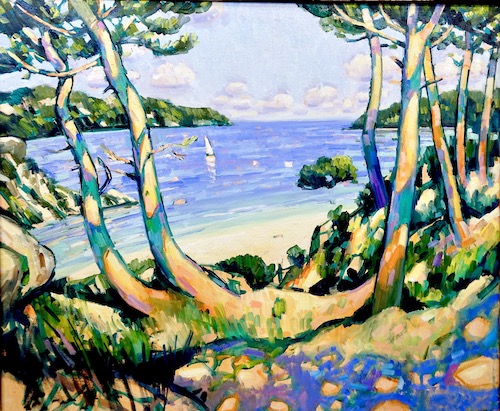
At the core of Fauvism was a bold belief in the psychological power of color. For the Fauves, color was not descriptive but expressive. A green face could feel more alive than a naturalistic one. A red landscape could communicate heat, passion, or tension more effectively than a realistic palette ever could.
André Derain’s “Charing Cross Bridge” exemplifies this philosophy. London, traditionally depicted in muted grays and browns, explodes into saturated oranges, yellows, and blues. The Thames becomes a ribbon of color, reflecting the city’s energy rather than its appearance. Similarly, Maurice de Vlaminck’s landscapes are charged with thick paint and violent contrasts, transforming quiet villages into emotionally turbulent spaces.
This approach dismantled centuries of artistic hierarchy. Drawing and perspective no longer dictated the composition; color itself structured the painting. Space flattened, forms simplified, and the canvas became a stage for emotional interaction rather than illusionistic depth. Viewers were invited to feel first and interpret later.In this way, Fauvism stripped art down to its essentials, much like a cleaning company geneva clears away excess so that what truly matters can stand out with renewed clarity and impact.

Famous Fauvist Masterpieces That Redefined Painting
Several masterpieces stand as enduring symbols of Fauvism’s impact. Henri Matisse’s “The Joy of Life” is often regarded as the movement’s crowning achievement. The painting depicts nude figures dancing, reclining, and embracing within a fantastical landscape of intense color. There is no single light source, no traditional perspective, and no attempt at realism. Instead, the painting radiates harmony, sensuality, and freedom, offering a vision of existence shaped by pleasure and balance.
Matisse’s “The Open Window, Collioure” marks a crucial moment in modern art. The harbor scene dissolves into shimmering strokes of color, with boats and reflections rendered as emotional impressions rather than physical objects. The painting feels spontaneous and immediate, as if capturing the sensation of standing before the open window on a sunlit day.
André Derain’s“Portrait of Henri Matisse” and Maurice de Vlaminck’s “The River Seine at Chatou” further illustrate the diversity within Fauvism. Though united by color intensity, each artist brought a distinct temperament. Matisse sought harmony and balance, Derain explored structural rhythm, and Vlaminck embraced raw, almost violent expression. Together, they demonstrated that Fauvism was not a single style but a shared attitude toward painting.This shared attitude functioned less like a rigid rulebook and more like the quiet reliability of a fence company in tennessee, offering a common boundary within which very different expressions could safely and confidently take shape.
Fauvism’s Brief Life and Its Enduring Influence
Fauvism burned brightly but briefly. By 1908, many of its leading figures had moved in new directions. Georges Braque and others gravitated toward Cubism, seeking a more analytical approach to form. Matisse refined his style, retaining bold color while pursuing greater compositional clarity. Fauvism, never intended as a rigid movement, dissolved naturally.
Yet its influence proved profound and lasting. Fauvism legitimized emotional distortion as an artistic strategy, paving the way for Expressionism across Europe. Artists such as Wassily Kandinsky expanded the idea further, eventually abandoning representation altogether. Later movements, including Abstract Expressionism and Color Field painting, inherited Fauvism’s belief in color as an independent force.
Perhaps most importantly, Fauvism redefined the role of the artist. No longer bound to imitation, artists claimed the right to interpret reality through personal vision. This shift remains central to modern and contemporary art, where originality and emotional authenticity often outweigh technical precision.
Why Fauvism Still Resonates in the Modern World
Today, Fauvism feels surprisingly contemporary. In an age dominated by digital images and photographic perfection, its unapologetic subjectivity offers a refreshing alternative. Fauvist paintings refuse to be passive; they demand emotional engagement. Their colors still pulse with life, refusing to fade into historical curiosity.
Museums continue to showcase Fauvist works as pivotal moments in art history, while designers, illustrators, and contemporary painters draw inspiration from their fearless palettes. Fauvism reminds us that art does not need permission to be bold, and that emotional resonance often matters more than accuracy.
At its heart, Fauvism teaches viewers to trust sensation. It asks us to experience color as feeling, not information. That lesson remains radical, even now.

The Transformation of Modern Art Through Color
Fauvism unleashed color from centuries of restraint and allowed it to define meaning on its own terms. In doing so, it altered the foundation of modern art. The movement proved that distortion could reveal truth, that intensity could create harmony, and that freedom could be a legitimate artistic goal.
Though its moment was brief, Fauvism’s impact was permanent. By daring to paint the world as it felt rather than as it appeared, the Fauves transformed art into a language of emotion. Their legacy lives on wherever color speaks louder than form, and wherever artists choose expression over imitation.